
As more global companies hire talent in India, understanding employee benefits is essential. Benefits help employers stay compliant and attract skilled professionals. While salary is important, benefits often influence a candidate’s decision to join or stay with a company.
In India, employee benefits fall into two categories. First, there are statutory benefits that employers must provide by law. Second, there are supplemental benefits that companies offer to stay competitive in the job market.
Therefore, foreign employers should understand both types of benefits before hiring in India. This helps avoid compliance issues, improves workforce planning, and provides a better employee experience.
In this guide, we’ll explain the key employee benefits employers should know about. We’ll also look at common market practices, employment costs, and how WeEOR helps businesses manage benefits administration.
Understanding Employee Benefits in India
Before designing a benefits package, employers should first determine how workers will be engaged. For example, businesses using contractors may have different obligations than those hiring employees. Our guide, Contractor vs. Employee in India — What’s the Legal Difference?, explains how worker classification can affect benefits eligibility and compliance requirements.

Employee benefits in India generally fall into two categories:
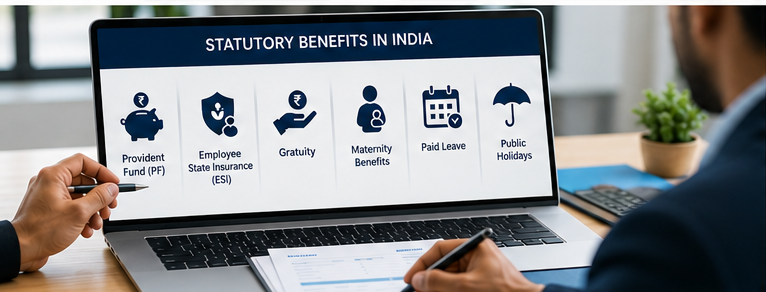
Statutory Benefits
These are benefits required by law and must be provided when applicable.
Examples include:
- Provident Fund (PF)
- Employee State Insurance (ESI)
- Gratuity
- Maternity Benefits
- Paid Leave
- Public Holidays
Supplemental Benefits
These are additional benefits employers may offer to remain competitive in the job market.
Examples include:
- Private health insurance
- Meal allowances
- Work-from-home stipends
- Wellness programs
- Learning and development budgets
Understanding both categories is important when calculating the true cost of employment.
Summary of Statutory Employee Benefits in India
| Benefit | Applicability | Employer Obligation |
|---|---|---|
| Provident Fund (PF) | Applicable establishments and eligible employees | Employer contribution required |
| Employee State Insurance (ESI) | Covered establishments and eligible employees | Employer contribution required |
| Gratuity | Eligible employees after qualifying service | Lump-sum payment required |
| Maternity Benefit | Eligible female employees | Paid maternity leave required |
| Paid Leave | Varies by state and company policies | Leave entitlement required |
| Public Holidays | All employees | Paid holidays required |
These benefits form the foundation of India statutory benefits compliance.
Provident Fund (PF)
The Employees’ Provident Fund (EPF) is one of India’s most important social security programs.
PF is designed to help employees build retirement savings through contributions made by both employers and employees.
Typical Contribution Structure
| Contribution | Employer | Employee |
|---|---|---|
| Provident Fund (PF) | 12% | 12% |
The contribution is generally based on eligible wages and is deposited into the employee’s provident fund account.
Why PF Matters
Provident Fund is often viewed by employees as one of the most valuable long-term financial benefits because it helps create retirement savings while also providing certain withdrawal options under specific circumstances.
Employers should ensure PF obligations are managed accurately as part of their broader compliance responsibilities.
Employee State Insurance (ESI)
Employee State Insurance (ESI) provides healthcare and social security benefits to eligible employees and their families.
The scheme typically applies to employees who fall within prescribed wage thresholds and work for covered establishments.
Benefits Under ESI
Employees may receive access to:
- Medical treatment
- Hospitalization benefits
- Sickness benefits
- Maternity support
- Disability benefits
- Dependent benefits
Employer Responsibilities
Employers must:
- Register eligible employees
- Make required contributions
- Maintain records
- Complete required compliance filings
For many workers, ESI serves as an important social safety net and forms a key part of mandatory benefits India employer obligations.
Gratuity
Gratuity is a statutory benefit designed to reward long-term service.
Employees generally become eligible after completing five years of continuous service with the employer.
When Is Gratuity Paid?
Gratuity is commonly payable upon:
- Resignation
- Retirement
- Superannuation
- Certain qualifying employment terminations
Why Employers Should Plan for Gratuity
Many foreign companies focus primarily on monthly payroll costs but overlook future gratuity liabilities.
As employee tenure increases, gratuity obligations can become significant. Businesses should account for these costs when budgeting for long-term workforce expansion.
Maternity Benefits
The Maternity Benefit Act provides important protections and benefits for eligible female employees.
One of the most significant requirements is paid maternity leave.
Maternity Leave Entitlement
Eligible employees may receive:
Up to 26 weeks of paid maternity leave
This entitlement makes India one of the countries with comparatively generous maternity leave provisions.
Additional Considerations
Employers may also need to comply with:
- Job protection requirements
- Return-to-work provisions
- Additional maternity-related obligations
Understanding maternity benefits is an important part of providing compliant employee benefits India programs.
Paid Leave Entitlements
Employees in India are generally entitled to paid leave, although specific requirements vary by state and industry.
Common leave categories include:
Casual Leave
Used for personal matters and short-term absences.
Sick Leave
Provided when employees are unable to work due to illness.
Earned or Privilege Leave
Accrued over time and typically used for vacations or longer planned absences.
State Variations
Leave entitlements are not uniform across India.
Employers should review applicable state-specific requirements regarding:
- Leave accrual
- Carry-forward rules
- Encashment provisions
- Minimum entitlement levels
Because regulations differ, businesses should avoid assuming a single nationwide leave standard applies.
Public and National Holidays
Employers must generally provide paid leave for designated public and national holidays.
Common National Holidays
Organizations commonly observe:
- Republic Day
- Independence Day
- Gandhi Jayanti
Additional state-specific holidays may also apply depending on the employee’s work location.
Why Holiday Compliance Matters
Holiday requirements often vary across states, making localized compliance management particularly important for distributed workforces.
Supplemental Benefits Commonly Offered in India
While statutory benefits establish a compliance baseline, many employers provide additional benefits to attract and retain top talent.
Private Health Insurance
Group medical insurance is one of the most commonly offered supplemental benefits.
Coverage may include:
- Employee medical expenses
- Family coverage
- Hospitalization benefits
- Preventive care programs
Meal Allowances
Many companies offer:
- Meal vouchers
- Food allowances
- Cafeteria benefits
Work-From-Home Stipends
Remote and hybrid work models have increased the popularity of:
- Internet reimbursements
- Home office allowances
- Equipment stipends
Learning and Development Programs
Organizations frequently support:
- Professional certifications
- Online training
- Skill development programs
These benefits can improve employee satisfaction while strengthening retention efforts.
Benefits by Employment Level
Not all employees receive identical benefit packages.
Junior-Level Employees
Benefits commonly focus on:
- Statutory compliance
- Basic health coverage
- Standard leave entitlements
Mid-Level Employees
Additional benefits may include:
- Enhanced insurance plans
- Performance bonuses
- Professional development budgets
Senior-Level Employees
Senior employees often receive:
- Executive health coverage
- Larger bonus structures
- Retirement planning support
- Additional leave benefits
While statutory obligations generally remain consistent, supplemental benefits often vary based on role, experience, and organizational policies.
Understanding CTC vs. Take-Home Pay
Benefits and payroll are closely connected. As a result, employers should understand how statutory contributions, deductions, and reporting obligations affect overall employment costs. Businesses hiring in India can also benefit from reviewing our India Payroll Compliance Guide for Foreign Companies (2025) for a deeper understanding of payroll requirements.
One area that frequently causes confusion for foreign employers is the difference between Cost to Company (CTC) and take-home pay.
What Is CTC?
CTC represents the total cost an employer incurs for an employee.
It may include:
- Base salary
- Bonuses
- PF contributions
- Insurance costs
- Gratuity provisions
- Other benefits
What Is Take-Home Pay?
Take-home pay refers to the amount an employee actually receives after deductions.
Why the Difference Matters
Many international employers underestimate the impact benefits have on employment costs.
When planning hiring budgets, businesses should evaluate:
- Salary costs
- Statutory benefits
- Insurance expenses
- Payroll taxes
- Compliance administration
This provides a more accurate picture of total workforce investment.
For companies hiring employees directly, understanding payroll obligations is equally important. Businesses should ensure employee benefits are coordinated with payroll compliance processes to avoid reporting and deduction issues.
Common Mistakes Foreign Employers Make
Assuming Benefits Are Optional
Many international businesses underestimate the importance of statutory benefits.
Ignoring State-Level Variations
Leave and holiday requirements may differ significantly between states.
Underestimating Total Employment Costs
Benefits can substantially increase overall employment expenses beyond base salary.
Poor Benefits Administration
Missed registrations, inaccurate calculations, or delayed payments can create compliance risks.
Lack of Local Expertise
Managing benefits without local knowledge often increases administrative complexity and compliance exposure.
How WeEOR Manages Benefits Administration
Furthermore, companies that do not have a legal entity in India can simplify hiring through an Employer of Record solution. If you’re unfamiliar with this model, our article What is an Employer of Record (EOR) and How Does It Work? explains how businesses can hire employees legally without setting up a local company.
Similarly, businesses evaluating expansion options may find our guide How to Hire Employees in India Without Setting Up a Legal Entity helpful when planning workforce growth.
In addition, companies comparing workforce solutions can review WeEOR pricing to better understand the costs associated with payroll, benefits administration, and Employer of Record services in India.
WeEOR helps companies simplify benefits management through compliant employment and payroll solutions.
WeEOR Services Include
- Employee onboarding
- Benefits administration
- PF management
- ESI administration
- Payroll processing
- Leave tracking
- Compliance monitoring
- Employee documentation support
- Statutory reporting assistance
For businesses expanding into India, WeEOR ensures employee benefits are managed accurately and in accordance with local regulations.
Companies exploring different workforce expansion options may also benefit from understanding how an Employer of Record (EOR) can simplify hiring and benefits administration without requiring a local legal entity.
Why Benefits Matter for Hiring Success
Competitive employee benefits are no longer viewed as optional perks. They play a critical role in recruitment, employee satisfaction, retention, and employer branding.
A well-designed benefits strategy helps organizations:
- Attract top talent
- Improve retention
- Increase employee satisfaction
- Maintain compliance
- Reduce administrative burden
By combining statutory compliance with competitive supplemental benefits, employers can build stronger teams and support long-term growth.
Conclusion
Understanding employee benefits in India is essential for staying compliant and attracting top talent. Employers must manage statutory benefits such as PF, ESI, gratuity, maternity leave, paid leave, and public holidays while also considering supplemental benefits that improve employee satisfaction and retention.
For global companies, managing these requirements can be complex. Need help with benefits administration, payroll, or compliance in India? Contact WeEOR today for expert support.
Let WeEOR Handle Your Benefits Administration
Managing employee benefits doesn’t have to be complicated.
WeEOR helps global companies administer statutory and supplemental benefits while maintaining compliance with Indian employment regulations.
Whether you’re hiring your first employee or building a larger team in India, our experts can support your workforce expansion every step of the way.
Get in touch today to learn how WeEOR can simplify employee benefits administration in India.
📧 Email: support@weeor.com